About Us

Established in March 2026, the School of Low-Altitude Technology is a strategic initiative by Jiangsu University to advance China's national low-altitude economy agenda and meet the demands of an emerging industrial landscape. Housed within the Faculty of Smart Agricultural Engineering, the school stands as a distinctive interdisciplinary school and a university-wide priority for innovation-driven growth.
The school leverages the university's core strengths in fundamental mechanics, intelligent control, electrical drive, and information sensing to cultivate an interdisciplinary innovation ecosystem – one that bridges engineering and science, integrates education with industry, and forges a distinctive identity in low-altitude innovation. We are committed to cultivating the next generation of creative, interdisciplinary talents who will shape the future of the low-altitude economy, and to establishing the school as a nationally leading and internationally influential base for talent cultivation and a hub for technological innovation.
Academic Programs
The school's academic architecture is anchored by a first-level discipline Ph.D. and Master's program in Mechanics, a postdoctoral research station, and a Ph.D. program in Agricultural Electrification and Automation – a national key discipline designated by the Chinese government. We also jointly administer two first-level discipline doctoral programs in Agricultural Engineering and Control Science and Engineering, and are independently establishing the interdisciplinary program of Low-Altitude Technology and Engineering.
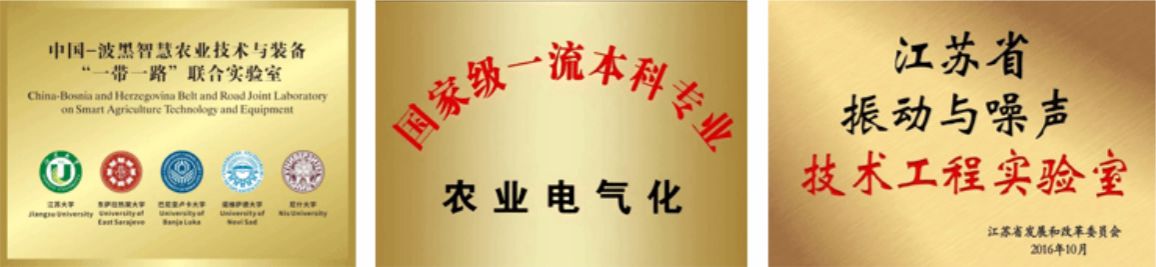
At the undergraduate level, we offer degree programs in Agricultural Electrification (a nationally designated top-tier program) and Engineering Mechanics, with a new major in Low-Altitude Technology and Engineering under accelerated development. We offer an integrated Bachelor–Master–Doctorate pathway. Our programs currently enroll 320+ undergraduates and 120+ graduate students, providing a seamless trajectory from foundational training to advanced research.
Faculty
Our faculty and staff comprise 75 members, including 64 full-time teaching faculty – 16 professors and 24 Ph.D. advisors. Among them are 3 national-level talent titles and 18 provincial and ministerial-level distinguished scholars, including Jiangsu distinguished professors and mid-career academic leaders under the "333 Project". The school is further strengthened by an international network of honorary and adjunct professors comprising leading academicians and renowned scholars worldwide. Together, they form a high-level teaching and research team with balanced structure, strong scholarship, rich engineering experience, and outstanding innovation vitality.
Research Platforms
At the national and international level, we are a partner in the China–Bosnia and Herzegovina Belt and Road Joint Laboratory on Smart Agricultural Technology and Equipment, the Ministry of Education Key Laboratory of Modern Agricultural Equipment and Technology, and more than 10 additional national and ministerial platforms, including key laboratories under the Ministry of Agriculture and Rural Affairs in plant protection equipment, Yangtze River Delta smart agriculture, and East China hilly-region agricultural mechanization.
Provincially, the school is also home to the Jiangsu Engineering Laboratory of Vibration and Noise Technology, the Jiangsu Key Laboratory of Electric Vehicle Drive and Intelligent Control, the Jiangsu Engineering Research Center of High-End Equipment Electric Drive and Control, the Key Laboratory of Facility Agriculture Measurement and Control Technology and Equipment for Machinery Industry, and the Key Laboratory of Mechanical Structure Damage Detection and Assessment Technology for Machinery Industry. These facilities underpin frontier research and interdisciplinary discovery, bridge engineering innovation and technology transfer, and strengthen collaboration with industry.
Global Engagement
We maintain active partnerships with 20+ leading global institutions, including the University of California, Berkeley, North Carolina State University, the University of Cambridge, the University of Plymouth, the Technical University of Munich, and the University of Sydney.
Through the Jiangsu Foreign Expert Studio, our students engage in international joint research, academic exchange, and innovation practicum. Students are eligible for full CSC scholarships to pursue master's and Ph.D. degrees abroad, ensuring a truly global trajectory for our most promising scholars.
Research Impact
The school advances innovation-driven research through large-scale platforms, collaborative teams, and major projects, aligning closely with national priorities in the low-altitude economy and China's agricultural-power strategy.
Research thrusts include lightweight aircraft design, intelligent flight control, multi-source information sensing, new-energy power systems, and smart low-altitude systems for precision agriculture. These efforts have produced high-impact breakthroughs and proprietary technology with direct industry application.
Over the past five years, our faculty have been awarded 40+ national and provincial projects funded by the NSFC, the National Key R&D Program, the Jiangsu Provincial Key R&D Program, and the Ministry of Agriculture and Rural Affairs, and have received 10+ provincial and ministerial science and technology awards.
Education & Graduate Profile
Our pedagogy is student-centered and outcome-based. Based in Jiangsu, with a national outlook and strong industry links, we draw on our strong disciplinary platforms to offer a distinctive educational environment. We cultivate graduates who are proficient in mechanics, well-versed in electrical engineering, expert in control, and strong in practice, and equipped with global perspective, inventive mindset, and professional capability.
Student Life & Recognition
Students have secured 50+ national and top-tier provincial awards in competitions including the "Challenge Cup" National Extracurricular Academic Science and Technology Contest, the National Mechanics Competition, the National Electronic Design Contest, and the National Intelligent Agricultural Equipment Innovation Competition.
Career Outcomes
Our graduates enter aerospace, low-altitude equipment manufacturing, smart agriculture, emergency management, new-energy systems, and rail transit. Employers consistently recognize them for rigorous technical training, hands-on capability, and a strong work ethic.